
We purchased a siphon pump for the express purpose of helping us to drain water more quickly from our ice
chest.
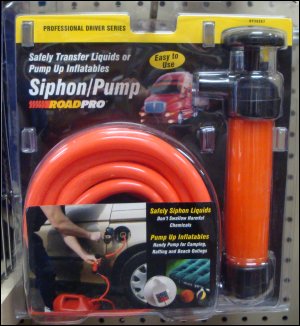 How well did it work for us?
This is our review of the siphon pump by RoadPro®.
Removing Liquid
There are numerous ways to remove water from an ice chest, including but not limited to:

- siphoning via siphon pump (or basting bulb),
- draining through the drain spigot,
- hand-dipping with a cup or bowl, or
- dumping the cooler upside down.
Since our preferred method of keeping food cold in our truck is by ice chest, we required a good bit of ice and as a result of the ice melting, had a good bit of water to remove.
Sometimes the amount of water from the melted ice (and the force behind it) in the cooler makes draining the water a messy proposition.
Hand-dipping can get cold.
Although Mike has been known to remove the contents for the purpose of cleaning out the cooler from time to time, dumping the cooler upside down inside the truck isn’t a viable option.
So, the only other options for removing water were
- either draining the ice chest out the door
- or to suction it out via siphon pump or basting bulb.
The Product
Many a truck stop sells siphon pumps like the one shown above.
We decided to purchase one in late 2009.
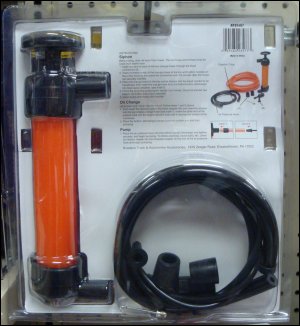
The directions on the back for assembling the unit seem straightforward enough.
When we opened the package, we noticed right away something that was not noticeable because the orange plastic hoses were
packaged behind the front label.
 One of the hoses had a “kink” in it.
We regret that we do not have a picture of it.
But Vicki has drawn an illustration to show that the flow of liquid through the device would be hindered by the kink.
Once kinked when packaged (and left for however long it took for us to buy it), the hose could never be “unkinked.”
The only avenue left to us was to cut off the hose above the kink, which we were unwilling to do.
Our Experience
We used the unit twice.
We noticed in unwinding the coiled plastic hoses that they tended not to be uncoiled very easily.
This made siphoning water from the ice chest out the door of our truck difficult.
The “curliness” required two people to hold the two ends of the hoses.
There was really nowhere decent for us to “put” the pump when pumping water out of the chest (which is not the fault of the pump itself).
But we gave it a shot.
 Vicki tried working the hand pump, which didn’t seem to want to draw the water out very well the first time.
After the barely passable first attempt to use this device, we dried it as best as we could and put it back in the package.
The second time — for whatever reason we don’t understand — the device did not work.
We do not know what caused the device to not work like it should.
It could have been
- the kink in one of the hoses,
- an error in assembling the parts, or
- operator error.
All we know is that it didn’t work for us.
The Disappointment
We were disappointed because we had foreseen that if the siphon pump worked, it would save some wear and tear on Mike’s back.
You see, at the time, Mike was having to lift the ice chest off the floor and onto the driver’s seat to drain the water out the door onto the ground from time to time.
(Every driver who uses an ice chest for cold food storage needs to be concerned about lifting it fully loaded with water and ice from floor level.)
We ended up taking the siphon pump back to the truck stop chain from which we had purchased it and getting a
refund.
Another Potential Help Dashed
For a while, instead of draining the water out the door, we were “recycling” the water through our Go Berkey® water purification unit to make drinking water.
The siphon pump could have helped us in our recycled water efforts, but unfortunately it did not.
 Money saving tip: Before buying a siphon, it would be a good idea to be able to see the entire length of the hose to make sure that it isn’t kinked.
Consider, too, if you want/need a siphon pump that requires two hands to operate, especially if you need to hold one or more of the hoses to keep them from recoiling.
Some people prefer a siphon pump that can be used in multiple circumstances, such as for use with a 55-gallon drum.
Besides foreseeing the circumstances in which you would use one, consider well the type(s) of fluid(s) that you plan to transfer.
Some devices might work better with certain liquids than others.
Are you transferring water, cleaning fluids, oils, volatile chemicals, fuel, or what?
Also, while we encourage shopping around for the best value you can get, you might be wise not to shop on the lowest cost alone.
Sometimes, lowest cost translates into an inferior product.
Be careful in using any siphon that requires putting an end in your mouth to create a vacuum, as use with a non-potable liquid could lead to sickness or death.
Finally, please note that it is considered theft to siphon fuel from another trucker’s vehicle for use in your own, and for this reason we strongly disapprove of this practice.
Return from Review of Siphon Pump by RoadPro(R) to our Product Reviews page or our Truck Drivers Money Saving Tips home page.