
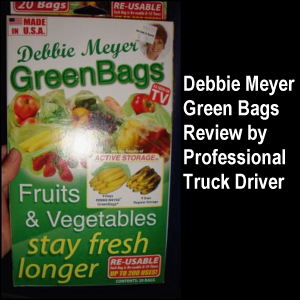
The benefit touted by Debbie Meyer Green Bags is that they will “prolong the life of your food.” They are targeted to work to extend the life (shorten the rapid spoilage) of fruits, vegetables and cut flowers.
 All of these agricultural products are said to release ethylene gas which “accelerates ripening, aging and rotting” after the products have been harvested or picked.
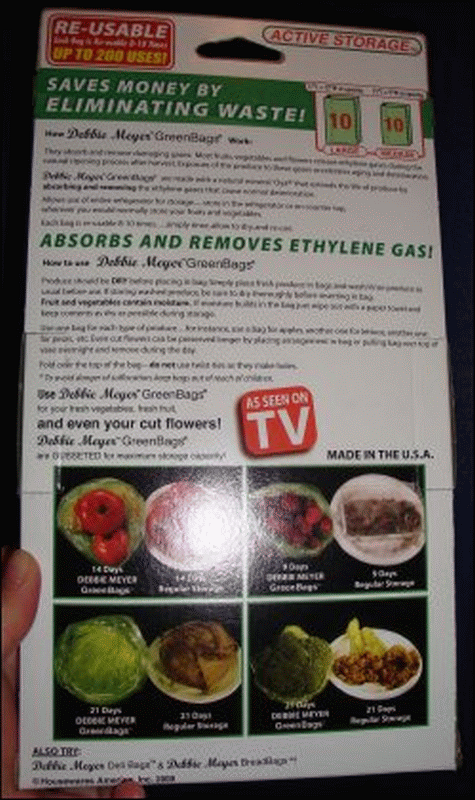
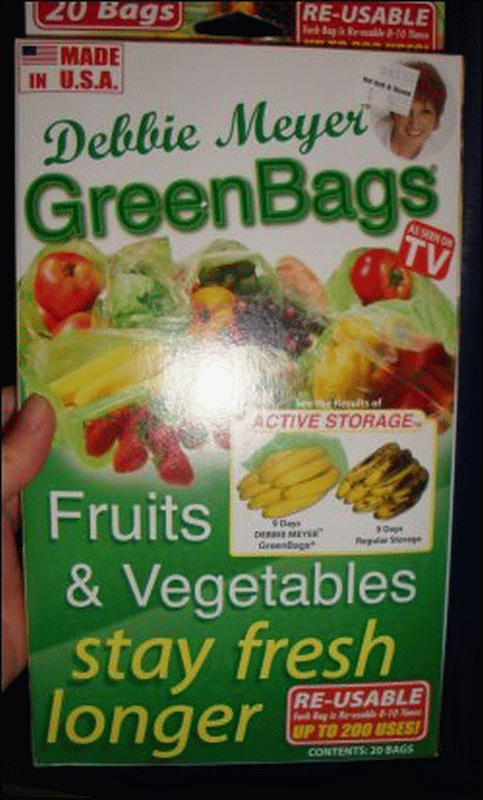 As stated on the box pictured to the right, the GreenBags “are made with a natural mineral ‘Oya®‘ that extends the life of produce by absorbing and removing the ethylene gases that cause normal deterioration.”
Fruits and vegetables that Debbie Meyer™ Green Bags® are supposed to work well on include: apples, asparagus, berries, broccoli, carrots, lemons, lettuce, melons, oranges, peaches, tomatoes and zucchini.

This page contains our review of this product, which we have tested on the fruits and vegetables that we eat most often in the truck that Mike drives for his trucking company — as well as some produce that we tried for a period of time but gave up on because they kept spoiling too quickly.
By way of background, when Mike was solo in the truck and coming home every weekend, he was packing enough food for one week out on the road at a time. Now that Vicki is in the truck with him full-time, we generally pack enough food for the two of us for at least two weeks and sometimes three.
We had hoped at the outset that the GreenBags would enable us to keep fresh produce fresh longer, especially since each bag is supposed to be re-usable 8-10 times.
Where Can Green Bags Be Stored?
It must be noted that the package specifically states that a bag “Allows use of entire refrigerator for storage… store in the refrigerator or on counter top, wherever you would normally store your fruits and vegetables.”
We choose not to use a compact refrigerator in the truck and do not store produce on a counter top because of the constant movement and vibration of the truck in transit. Instead, we use an ice chest to keep perishable foods cold and store not-as-perishable fruits and vegetables in a different set-up altogether.
So that you will know: We never did store any fruits or vegetables that we had moved into Green Bags in our ice chests.
Storing Fruits and Vegetables in a Truck
We have used a number of different room temperature storage devices to hold fruits and vegetables in our trucks over the years. Here are three of them.
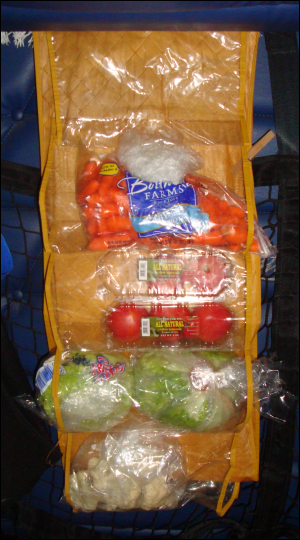 First, we used a transparent shoe organizer (one side of which is pictured at left) to store vegetables for a period of time.
The drawbacks to using this were that:
- the pouches for holding shoes were too small to hold very large vegetables and
- it was not designed to hold a significant amount of weight.
The vegetables pictured are (in consecutive vertical pouches, starting with the second pouch) mini carrots, small tomatoes in their stiff plastic holders, two heads of iceberg lettuce and segmented cauliflower.
After the shoe organizer torn irreparably under the weight of the vegetables over time, we had to get rid of it.
Next, we used a 6-shelf hanging organizer (like the one shown at left except ours is blue and has two velcro fasteners at the top) to store fruits and vegetables for a period of time.
The drawbacks to using this were that:
- the fasteners (designed to clasp over a closet rod) were not designed to be hung from the lip of an upper bunk (Vicki had to loop a stretch cord with hooks through the closed velcro fasteners to hang it);
- the device was too long to maximize the vertical space between the bottom of the upper bunk and the top of the lower bunk mattress to utilize all six shelves; and
- the shelves were too “tall” to store lots of little vegetables separately (a situation Vicki attempted to fix with a stapler but it didn’t stay fixed under the weight of the produce).
We no longer use our hanging organizer in the truck.
Currently, we put whatever limited number of fruits and vegetables we do not store in our ice chests in a 3-tier hanging basket (like the one shown at left). The fruits and vegetables that we store there have a longer shelf life, like apples and onions. We hang the hook from the lip of the top bunk (in the lowered position) along the back wall of the sleeper berth.
The drawbacks are that:
- the baskets sway with the motion of the truck (side-to-side and forward away from the back wall) and
- the hard surfaces of the basket can lead to bruised or otherwise damaged fruits and vegetables with every bump of the truck (unless we provide cushioning from plastic bags, paper towels or cloth towels).
Besides apples, the other raw fruits that we routinely eat are bananas and peaches.
Besides onions, the other raw vegetables that we routinely eat are iceberg lettuce, tomatoes and carrots.
We have tried storing broccoli and cauliflower in various ways and found them very sensitive. Unless we eat them within a day or two, they go bad.
Just How Big and Sturdy Are They?
The GreenBags box contained 20 bags:
- 10 medium bags: 15 inches long by 9 inches wide at opening and
- 10 large bags: 17 inches long by 12 inches wide at opening.
To their credit, the bags are thicker than regular resealable plastic storage bags and felt sturdier than the freezer-type resealable plastic storage bags. However, they have no seals on them and do not come with any kind of tie (plastic or wire).
These photos show which pieces of produce we put in which size bags:
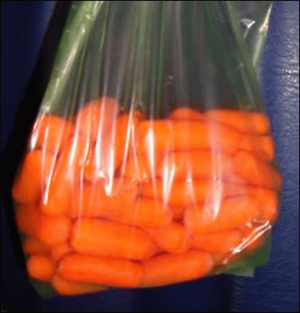 Mini carrots were placed in a medium Green Bag instead of the plastic bag that they were sold in.
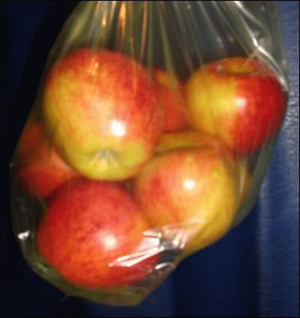 Gala apples (or another variety of apples) were stored (depending on the number) in medium or large Green Bags.
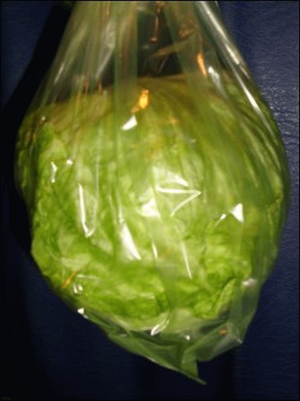 Iceberg lettuce due to its size was stored in a large GreenBag.
If the head was especially large, it would not fit even in the large bag.
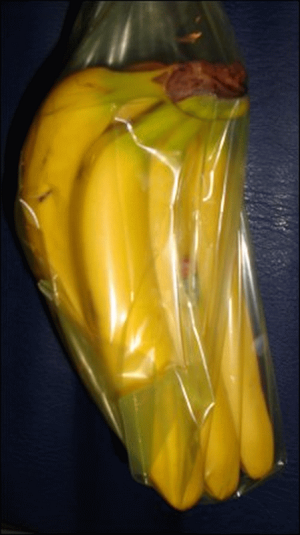 Bananas were stored in a large (long) GreenBag.
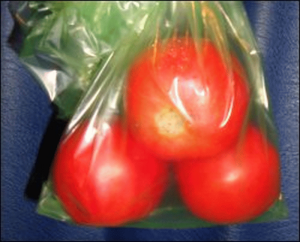 Tomatoes (whatever variety we bought) were stored (depending on the number) in medium or large Green Bags.
Did Any Food Spoil?
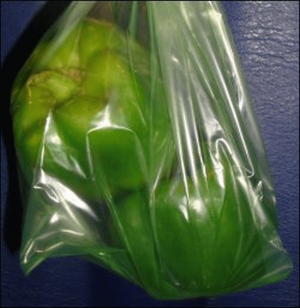
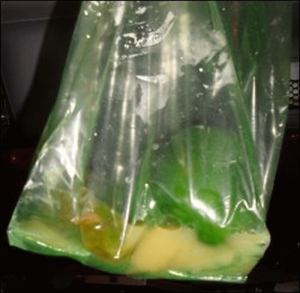
It was distressing any time we had spoiled food, especially if it was produce stored in a Debbie Meyer Green Bag. Below are two photos of green peppers in a medium GreenBag. They may not necessarily be “before and after” shots, but they serve a very good purpose by showing what the fresh produce looked like just after going in the bag (on the left) and the spoiled produce looked like after having been in the bag for a few days (on the right). In other words, GreenBags are not foolproof; they will not keep food good indefinitely.
Green Peppers and Spoiled Green Peppers
General Observations about Fruit and Vegetable Storage in a Truck
We found that in general, foods that were selected from a refrigerated case in the grocery store needed to be kept cool — not stored at room temperature — in the truck. The Green Bags did not extend the lives of vegetables removed from their optimum coolness.
We found that there can be aspects of vegetables that affect the longevity of their freshness that cannot be seen from the outside. For example, a perfectly lovely looking head of lettuce can have something go wrong in its core that tends to make it spoil faster from the inside out.
We found that
- the vegetables that spoiled fastest are green peppers, cauliflower and broccoli;
- the vegetables that stayed freshest longest are onions and sweet potatoes (which can be stored at room temperature);
- the fastest spoiling or bruising fruits are peaches and bananas;
- the fruits that stayed freshest longest are apples (although even they can get mealy after being stored at room temperature for a while);
- tomatoes can become bruised quite easily in an ice chest (especially if they have no exterior protection); and
- lettuce can still be crisp and yet turn a little brown.
While we have found that the Debbie Meyer Green Bags have helped extend the lives of some fruits and vegetables, we have also had the following foods spoil in the truck while packed in a Green Bag: bananas, green peppers, tomatoes, cauliflower and broccoli.
Conclusion
We purchased our box of Debbie Meyer™ Green Bags® at a Bed, Bath and Beyond store “for free” with gift cards “purchased” with rewards points from one of our credit cards. Even though we paid nothing out-of-pocket for the item, we still applied our same standard of evaluation as if we had spent the $9.99 out-of-pocket.
When reviewing this product, we did not do side-by-side comparisons of food stored in regular plastic bags versus the green bags. However, in our opinion, the benefits that using these bags are supposed to deliver do not equal or exceed the cost, at least under the conditions in which we used them.
Wikipedia indicated that numerous entities had tested this product and states, “Consumers Union (publishers of Consumer Reports magazine) evaluated the product in July of 2008 and could not identify significant benefits over other produce storage methods alone. It does work on some fruits and vegetables like peaches and carrots.” (reference)
We will not be buying them again. For this reason, we will not be providing a link through which you can buy them on our site.
 Money saving tip: All produce should either be eaten or preserved in a timely manner. Depending on the specific item, it may be eaten raw or prepared/cooked. Popular preservation methods include dehydrating, canning and freezing. Even so, foods preserved by these means must still be consumed prior to spoiling. Refrigeration can retard spoiling for only a limited period of time.
For the best freshness, produce should be purchased as soon as possible after harvesting. Farmers’ markets may provide the most quickly harvested foods, being brought to market by the growers within 24 hours.
Consider carefully the items you use in which to store produce: plastic bags, plastic bowls, glass, metal, etc. Some produce should not be stored in specific kinds of storage devices. For example, tomatoes (high in acid) should not be stored in metal. Certain types of plastic bags (such as those with holes built in) may help extend the life of certain types of produce.
Return from Debbie Meyer Green Bags Review by Professional Truck Driverto our Product Reviewspage or our Truck Drivers Money Saving Tips home page.