
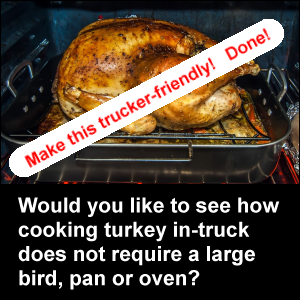
 The idea of cooking turkey — especially if it is a huge one like the kind you envision being served on an episode of “The Waltons” — does not appeal to most professional drivers because of the space needed to store it, the equipment needed to cook it, and the fuss and bother of dealing with grease, skin and bones.
So, how do you make cooking turkey “trucker-friendly”?
On this page, we will share with you some tips on how to deal with obstacles so that you can enjoy this delicious entree whenever you want.
Below is a photo of Thanksgiving dinner we cooked totally in Mike’s truck in 2009.

You will see turkey, bread dressing, sweet potato casserole, steamed broccoli and cranberry sauce.
Boneless Turkey
 We wanted turkey as our entree for Thanksgiving while eliminating as much waste and clean up as possible.
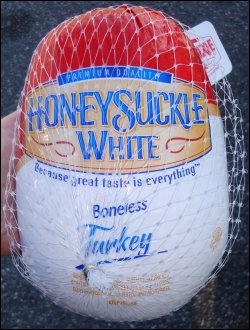
To achieve this, we purchased a 3-pound Honeysuckle White “boneless turkey” (containing both white meat and dark meat) so as not to have to deal with the bones and skin.
Vicki’s mom says that this is one of the best brands of turkey available.
The meat was frozen when we bought it and we stored it in our ice chest until we were ready to cook it.
 This close-up photo shows the label from the boneless turkey we bought for preparing Thanksgiving dinner in our truck.
The “bird” was comprised of both white and dark meat.
There were truly no bones.
There was only one small piece of skin.
How were we going to cook it?
A Dab of Humor: Cook by Engine Heat?
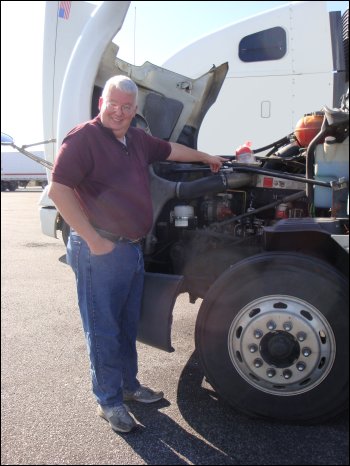 Vicki took this photo for laughs.
Mike had a little fun by showing two different ways that professional drivers “could” use for cooking turkey.
We don’t recommend either of these methods, but we don’t doubt that some adventurous truckers have tried these or other creative ways to cook or heat their meals on or in their trucks…
We took this photo for laughs.
Mike is standing beside his truck with the hood up.
He is pointing to the packaged turkey sitting in a pan on top of the engine.
It is certainly an unconventional method to use the engine’s heat for cooking turkey (or any food).
Additional measures (including taking the food out of the packaging) would need to be taken in order to make it work.
Interestingly enough, the truck that we team drove for U.S. Xpress in the mid-1990s had been driven at some point in the past by someone who had attempted to warm up a can of Campbell’s Chunky Soup by the heat of the engine.
However, after getting the can down into a likely place near the engine where it would not fall out while the truck was in motion, the driver could not remove the can.
There is no telling how long that the can had been there and how many times it had been heated and cooled.
Nowadays, drivers have many other meal preparation and cooking methods available to them that they don’t need to resort to using the heat from their trucks’ engines to cook food.
A Dab More Humor: Cook by Exhaust Stack Heat?
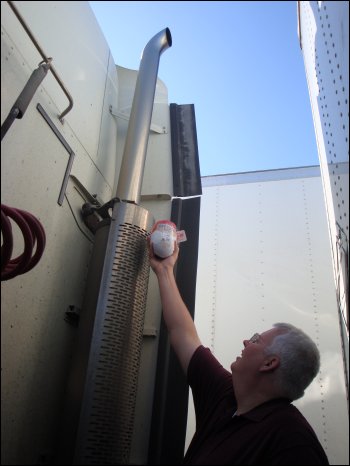 Vicki also took this photo for laughs.
As if he were going to use this method for cooking turkey, Mike is holding the boneless turkey — still in its packaging — up next to the exhaust stack on the back of the tractor he drives for his trucking company.
Although he does not recommend using it, he has no doubt that some adventurous truckers may have tried this method of using the truck’s heat to cook or heat a meal.
Methods of Cooking Turkey
Using a turkey fryer requires using
- a lot of oil,
- an outdoor area that is level and able to handle the heat from the fryer, and
- access to the outdoor area for the length of time that your bird will need to cook.
This may be impractical for you if as a professional driver you need to travel for hours in a single a day.
If you’re thinking about oven roasting your bird, you will need
- an oven (or toaster oven) big enough to accommodate the bird and
- to be parked long enough to cook the turkey thoroughly.
You certainly don’t want to set a bird to cooking with grease accumulating in the bottom of a non-covered pan only to hit a bump en route, spill the grease and start a fire!
Another way to have turkey in your truck is to heat up what your home support team has already cooked at home.
Besides the methods already described, you may also choose to use a Jet Stream Oven or other convection oven for cooking turkey.
The Way We Like to Cook Turkey in a Truck
Our favorite way of cooking turkey in the truck is using a crock pot (slow cooker) because we don’t have to worry about the bird drying out or burning.
We simply plug the appliance into an inverter, set it on low and let it go. The lid keeps the moisture in, especially if it is tied down.
When he was ready for cooking turkey, Mike opened the package and removed the plastic net and plastic bag from the exterior of the meat.
He left, per the instructions, the stretchy netting intact around the meat during the cooking process.
 In this photo, you will see the boneless turkey we bought — out of its packaging and placed in a Reynolds slow cooker liner inside our medium-sized crock pot — prepared for cooking.
Per the instructions, Mike had rubbed oil (olive oil, in our case) around the meat, which remained inside its fabric netting during the cooking cycle.
For our taste, Mike did not use the gravy packet that came with the turkey, partly because of the high sodium content.
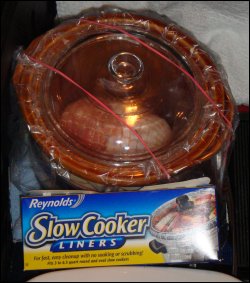
Mike stretched a large rubber band over the top of the lidded appliance and around the knobs on the sides to keep the lid in place while he drove down the road.
In a different truck and in cases where we did not have a large rubber band to anchor the lid, we placed the crock pot on the floor near the passenger’s seat and kept the lid in place by the weight of a suitable and folded up blanket.
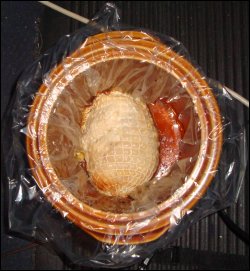 At the end of a pre-determined driving shift, Mike removed the crock pot from under the bunk and took off the lid.
This method of cooking turkey worked very well!
There wasn’t very much broth, but it was enough to be able to make one-loaf batch of bread dressing.
Unlike an “oven bag” (which is meant to be used in an oven), a crock pot liner is meant to be draped over the sides of the appliance after which the lid is put on.
By 12:30 p.m., the turkey was beginning to cook. Four hours later, we started to smell the luscious aroma of cooking turkey.
Yum!
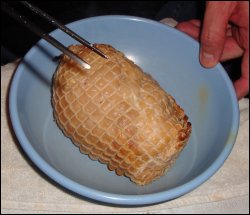 Mike removed the cooked boneless turkey from the crock pot and put it in a bowl.
Pictured here, it is still in its netting.
Mike removed the netting with a knife.
In another case, he cut the stretchy net off the meat with a pair of heavy duty scissors.
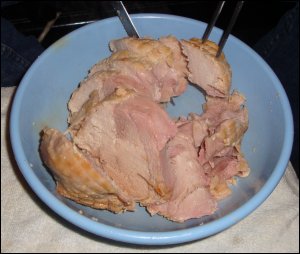 Mike sliced the boneless turkey into portions for Thanksgiving Dinner and turkey leftovers.
From one 3-pound piece of meat, we made three meals for two people (6 servings).
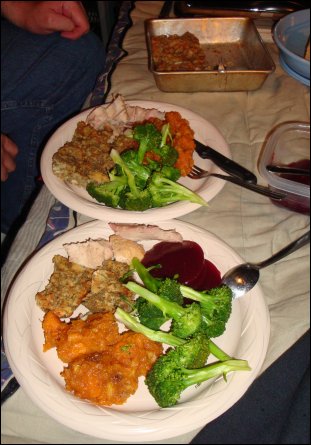 Thanksgiving dinner is served!
Both plates show a serving of turkey, bread dressing, sweet potato casserole and steamed broccoli.
The plate in the foreground also shows jellied cranberry sauce.
You can see the edge of the bowl with jellied cranberry sauce on the right and the pan containing the remainder of the bread dressing in the background.
Equipment We Used for Cooking Turkey in Mike’s Truck
Cost of This Entree in 2009
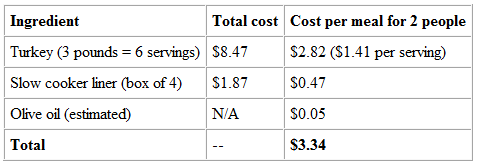
You can’t even get a full meal at a restaurant for the price of this entree.
 Money saving tip: Obviously, you can save money by eating turkey that you’ve cooked in your truck when compared to eating a restaurant meal.
But both your money and your time are valuable.
Using a crock pot for cooking turkey while you’re rolling down the road makes sense compared to having to cook it once your vehicle is parked.
With a little advanced planning, you can save on clean-up time, too.
We were very familiar with using Reynolds Oven Bags for roasting turkeys in a standard oven.
So we experimented and tried using a “slow cooker liner” for the first time ever when we cooked our 2009 Thanksgiving dinner.
Mike declared that using the slow cooker liner dramatically reduced clean-up time compared to what he would have spent if he had put the turkey directly into the crock pot without it.
If you are willing to let your crock pot soak, either with or without additives to help clean it, you can save yourself the expense of slow cooker liners.
If you can, compare prices of similar turkey items at the stores. The least expensive one (overall or per pound) may not be the best value.
Once, we tried a Jenni-O turkey that was on a really good sale; to our taste, it was so salty that it was practically inedible.
You’ll want to gauge which items to compare by the amount of storage room you have in your ice chest or compact refrigerator and the amount of cooking space you have in your appliance.
Finally, be aware of any drowsiness that may come on as a result of eating turkey.
Turkey meat has a high amount of tryptophan, an essential amino acid in the human diet which some people use as a sleeping aid.
If you find yourself getting drowsy, find the nearest safe and legal place to park.
It is better to park for a little while until the drowsiness passes than to risk getting involved in an expensive (and potentially life-threatening) accident.
Return from Cooking Turkey for Thanksgiving or Any Time in Your Truck to our Food and Recipes page or our Truck Drivers Money Saving Tips home page.